Showing posts with label EXTRA-ACTIVITIES. Show all posts

Saturday, 11 July 2020

PLANTS: USES AND CURIOSITIES

Read the texts below and complete the table with the information of each plant.


Text 1:

A dragon tree (Dracaena draco) is usually found in dry forests on the Canary Islands and the Azores.
It grows to approximately nine metres and has a long trunk and prickly leaves. The leaves are about 50 centimetres long. The flowers are white and have a sweet smell. However, flowering occurs only every fifteen years. The oldest dragon tree is around 650 years old. We can tell the age of the tree by the number of branches.
The sap of the dragon tree is used as a colouring for both toothpaste and medicines.
Find out more about the dragon tree. Where does its name come from?


Source: adapted from https://en.wikipedia.org/wiki/Dracaena_draco


Text 2:

The Spanish fir (Abies pinsapo) is an evergreen tree with small, needle-like leaves. It can grow to 30 metres and live up to 200 years. The make cones of the Spanish fir are quite unusual, because they are purple and look like raspberries. The Spanish fir  can be found in southern Andalusia and northern Morocco. The Spanish fir is of great value to scientists due to its uniqueness. For this reason, considerable conservation efforts are being made. The existence of the Spanish fir is however, threatened by fires, soil erosion and urban projects.


Source: adapted from https://en.wikipedia.org/wiki/Abies_pinsapo


Text 1
Text 2
Common name


Scientific name


Classification


Habitat


Size


Life span


Use/value


WATER LILIES

Watch the following video about how water lilies adapt to the environment.


Write a short text and explain how water lilies adapt to water.

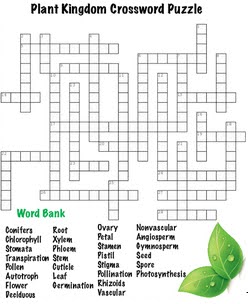
PLANT KINGDOM - CROSSWORD PUZZLE

Complete the crossword puzzle:


Check your answers

Source: https://www.teacherspayteachers.com/Product/Plants-Intro-to-Plant-Kingdom-Crossword-Puzzles-Set-of-2-603420


Monday, 6 July 2020

PLANT NUTRITION – FUNCTIONS OF LEAVES, STEMS AND ROOTS

Work in pairs. Take turns to read. Then classify the sentences and write the numbers.


PLANTS REPRODUCTION

Match the words with the descriptions below. Then put the stages of reproduction in the correct order. 


Germination - Fertilization - Fruit and seed - Formation - Pollination - Dispersal 


 ____________: pollen reaches the stigma, penetrates it and fertilizes the ovules inside the ovary. 


 ____________: the seeds fall on the ground and germinate. A small root and shoot grow. 


 ____________: the ripe fruit falls off the plant or releases the seeds. 


 ____________: the fertilized flower is transformed. The corolla and the calyx dry up. The ovary changes into the fruit. 


 ____________: pollen from one flower’s anther reaches the stigma of another flower. 

Thursday, 2 July 2020

PLANTS AND HABITATS

Watch the video about plants in different habitats.


Can you name three plants of each habitat?

Which ones can you see in the Andalusian Community?

Saturday, 22 February 2020

PLANTS FEATURES - mind map

The students have been studying the features of plants and they have completed this mind map:


Great job!!!
kudos to you!